
Red Gum Lerp Psyllid
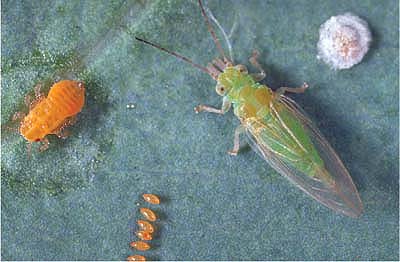
The Red Gum Lerp Psyllid (Glycaspis brimblecombei) is an insect that is native to Australia. In June 1998, this insect invaded California and was first found in Los Angeles County. This pest feeds exclusively on species of Eucalyptus and in California it exhibits high preference for river red gum (Eucalyptus camaldulensis), flooded gum (E. rudis), and forest red gum (E. tereticornis). Red gum lerp psyllid has demonstrated remarkable invasion potential. After its initial discovery in California, red gum lerp psyllid was found in Baja California, Mexico in 2000, Florida and Hawaii in 2001, Mauritius 2001, South America in 2002, and Portugal and Spain in 2007. This pest is a major threat to susceptible Eucalyptus species that are grown in urban landscapes, as wind shelters, or as commercial forests.
Psyllid nymphs and adults feed on sugar rich phloem. Honeydew, is a sticky waste product excreted by nymphs and adult psyllids after digesting phloem. As nymphs feed they can use honeydew excretions to form a protective white cap called a "lerp," the conspicuous white cone seen on eucalyptus leaves. Nymphs feed and grow to adulthood under this crystalline cap. Upon completing development, winged adults leave the protection of the lerp and fly to new plants to mate, feed, and lay eggs.
High density red gum lerp psyllid populations secrete large amounts of honeydew and excessive feeding pressure causes premature leaf drop. Heavily infested leaves are readily noticeable because of the large numbers of white lerps encrusting the leaf surfaces. Falling leaves foul surfaces beneath infested trees such as vehicles parked under trees, and swimming pools, the bottoms of shoes are soiled when sticky leaves are walked on, and leaf drop results in the rapid accumulation of flammable material beneath trees and on the rooftops of houses and other buildings. Extensive and repeated defoliation events weaken trees, and contributes to the premature death of some highly susceptible species, in particular E. camaldulensis. In Southern California, thousands of mature E. camaldulensis were killed within 2-3 years by uncontrolled populations of red gum lerp psyllid. The removal costs for these dead trees have cost home owners, city councils, community groups, and utility boards millions of dollars. Honeydew excretion promotes the unsightly growth of black sooty molds on leaves and branches, and honeydew dripping from heavily infested trees can stain concrete sidewalks.


Vivid II (Abamectin) Tree Tech Microinjection Insecticide, 2 mL.

 This product is drop-shipped by the manufacturer and will be shipped UPS Ground regardless of method chosen at checkout.
 State Registrations: Please check TreeTech's state registrations Here to see if this product can ship to your state.


